

If you make soup for a small household but occasionally cook pasta or broth in quantity, choosing a stockpot is a trade-off between capacity and manageable handling. A larger pot gives ingredients room, but takes more storage space and can be heavier when filled. This Best Stainless Steel Stockpots guide compares six options by size, base construction, compatibility, and cleanup design so you can match a pot to your routine.

Pros
- Large 12-quart capacity
- Stainless steel construction
- Induction compatible
- Impact-bonded base
- Includes a lid
Cons
- Large capacity may be excessive for smaller households
- Who should skip it: shoppers needing a compact everyday pot

Pros
- Large 12-quart capacity
- Aluminum-encapsulated base
- Helper handle for lifting support
- Tapered pouring rim
Cons
- Large capacity may be cumbersome to store
- Who should skip it: cooks who rarely need a large pot

Pros
- Compatible with several cooktop types, including induction
- Stainless steel construction
- Lid included
- Available in larger listed sizes
Cons
- 6.5 quarts may be small for large canning batches
- Who should skip it: cooks needing a larger-capacity stock pot
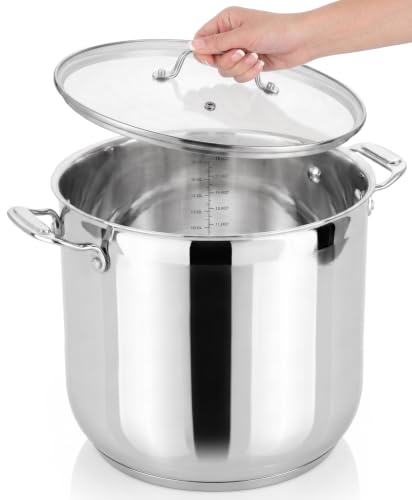
Pros
- Large 19-quart capacity
- Compatible with multiple stovetop types
- See-through tempered-glass lid
- 18/8 stainless steel interior
Cons
- Hand washing is recommended to preserve shine
- Large capacity may not suit smaller-batch cooking
- Who should skip it: cooks seeking a compact stockpot
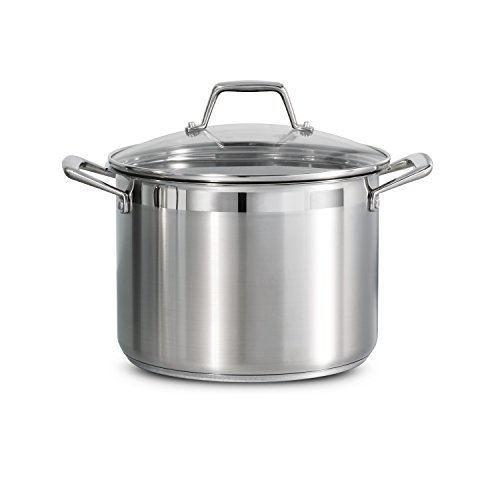
Pros
- Large 8-quart cooking capacity
- Integrated lock-and-drain strainer
- Compatible with induction stovetops
- Clear lid for monitoring
- Dishwasher-safe construction
Cons
- Oven-safe only to 350°F
- 7.5-pound weight may feel substantial
- Who should skip it: Shoppers wanting a lightweight or high-heat pot

Pros
- Built-in straining lid
- Stainless steel construction
- Cup and liter measurement markings
- No separate colander needed
Cons
- 6-quart capacity may limit larger cooking tasks
- Skip it if you need a larger-than-6-quart pot
Capacity and the batches you actually cook
Capacity is the first decision because it affects both cooking room and everyday handling. The products here range from a 6-quart pasta pot to a 19-quart stockpot, with several options between them. A smaller pot is generally easier to fit in a cabinet and handle on the stove, while a larger one is intended for bigger batches, but capacity alone does not establish a serving count.
The Cuisinart 6-quart and SUNHOUSE 6.5-quart pots are the smallest listed choices. For more room, the Tramontina is 8 quarts, the Cuisinart cookware set includes a 12-quart pot, and the SUNHOUSE stockpot is 12 quarts. NutriChef’s 19-quart capacity is aimed at large-volume cooking. Before buying, consider the largest recipe you regularly make and whether the pot will fit your storage space and cooktop.
Base construction and heat distribution
Stockpots are often used for boiling and simmering, so base construction matters when you want heat spread across the pot’s bottom. The Cuisinart 12-quart listing specifies an aluminum-encapsulated base, while the SUNHOUSE 12-quart listing describes an impact-bonded base. The 6.5-quart SUNHOUSE specifies a 5-ply base, and Tramontina lists an impact-bonded tri-ply base.
These are different construction descriptions, not a direct performance ranking. NutriChef also lists an impact-bonded base. If your cooking includes long simmers or thick sauces, check the maker’s construction details and use a burner suited to the pot’s base. The Cuisinart 6-quart product information does not specify its base construction, so verify that detail if it is central to your choice.
Cooktop compatibility and oven limits
Stainless steel does not automatically mean a pot works on induction. The SUNHOUSE 12-quart and 6.5-quart listings state induction compatibility and list other cooktop types. NutriChef and Tramontina also specify induction compatibility. Cuisinart’s 12-quart listing gives an oven limit of 550°F, while Tramontina lists an oven limit of 350°F. For NutriChef, the listing gives a 500°F maximum except for the glass lid.
Do not infer oven suitability or an oven limit for a product when its supplied details do not provide one. If you plan to move a pot from stovetop to oven, confirm the limit for the complete pot and any lid or handles, rather than relying on a general material description.
Lids, straining, and task-specific design
A standard lid suits general stock and soup cooking, while a built-in draining design can simplify pasta preparation. Tramontina’s 8-quart pot has a transparent lid with an integrated lock-and-drain strainer. Cuisinart’s 6-quart pasta pot has a straining lid that fastens in place and measurement markings in cups and liters. These features can reduce the need to reach for a separate colander, but they make most sense if pasta is a regular task.
The NutriChef 19-quart pot has a see-through tempered-glass lid with a steam vent. The Cuisinart 12-quart listing specifies a tight-fitting lid, while the SUNHOUSE listings include lids but do not provide further lid details here. Choose a draining design for pasta workflow, or a conventional covered pot if you mainly make broth, soup, or large batches.
Cleaning, handling, and storage
Large pots take up more cabinet space and can be cumbersome to lift when full. NutriChef lists a weight of 7.4 lb with its lid and dimensions of 16.45 by 12 by 13.4 inches, useful details to compare with your cabinet and sink. The other listings do not provide comparable dimensions or weights, so check those before ordering if storage or lifting is a constraint.
Tramontina states that its pot is dishwasher-safe, and NutriChef’s listing says dishwasher-safe but recommends hand washing to preserve the exterior shine. The Cuisinart 12-quart listing describes a stainless cooking surface that does not discolor, react with food, or alter flavors; it does not specify dishwasher care. Confirm care instructions for the exact model, and remember a large pot may be awkward to wash even if it is dishwasher-safe. Browse other cookware options if your needs extend beyond stockpots.
How We Compared These Products
This comparison evaluates the supplied product specifications and design descriptions, including capacity, base construction, stated cooktop compatibility, lids, draining features, and care guidance. The product information provides ratings but no written customer feedback, so those ratings do not establish recurring owner experiences. This guide is based on product research, not firsthand assessment. See our editorial research method for more about how we evaluate products.
Which Option Fits Your Kitchen?
For a smaller pot with a thicker specified base: Consider the SUNHOUSE 6.5 QT Stock Pot with Lid if its capacity suits your usual batches. Its listing specifies a 5-ply base and induction compatibility. Who should skip it: cooks who regularly need a very large pot or want a pasta strainer built into the lid.
For large batches: The NutriChef 19-Quart Stainless Steel Stockpot offers the largest listed capacity and includes a see-through vented lid. Its listed weight and dimensions make cabinet and sink fit worth checking. Who should skip it: anyone with limited storage or no need for a high-capacity pot.
For pasta and easier draining: The Tramontina Lock & Drain Stainless Steel 8-Quart combines an 8-quart capacity with a lid that locks and drains. Who should skip it: shoppers who prefer a basic stockpot lid and do not expect to use the integrated strainer. If you are choosing among sizes, prioritize the largest batch you cook often, not an occasional outlier.
Frequently Asked Questions
Are all the listed stainless steel pots induction-compatible?
No. The supplied details specifically state induction compatibility for both SUNHOUSE pots, NutriChef, and Tramontina. The Cuisinart product descriptions provided here do not specify induction compatibility, so check the exact product information before buying for an induction cooktop.
Which option is smallest?
The Cuisinart 766S-22 is a 6-quart pasta pot, followed by the SUNHOUSE 6.5-quart stockpot. Consider whether the smaller capacity is enough for your usual recipes, and verify dimensions if cabinet space is tight.
Which pot is designed for draining pasta?
Tramontina’s 8-quart model has a transparent lid with an integrated lock-and-drain strainer. Cuisinart’s 6-quart pasta pot has a fastening straining lid and measurement markings. These features are useful for pasta, but are not specified for the other stockpots.
Can I put these pots in the oven?
Some supplied listings state oven limits: Cuisinart’s 12-quart pot is listed to 550°F, Tramontina to 350°F, and NutriChef to 500°F except for its glass lid. The provided details do not establish oven limits for every product. Verify the exact pot, lid, and handle limits before oven use.
Are stainless steel stockpots dishwasher-safe?
Care instructions vary. Tramontina is listed as dishwasher-safe. NutriChef is also listed as dishwasher-safe, though hand washing is recommended to preserve its shine. Do not assume that applies to every pot; check the care guidance for the model you select.
What should I check before buying a large stockpot?
Check the pot’s dimensions, weight, cooktop fit, and storage location as well as its capacity. NutriChef provides dimensions and a weight with lid, while comparable figures are not included for all other options. A pot that suits your recipes still needs to fit your kitchen and be manageable to lift and clean.




Write Your Review
No reviews yet. Be the first to share your experience!