

A damp basement can turn a simple appliance choice into a placement and maintenance problem. A small unit may require frequent tank emptying, while a larger compressor model may take more floor space and need a suitable gravity-drain path. The wrong choice can leave you managing water manually or paying for capacity your room does not need.
This guide to Best Basement Dehumidifiers With Drain Hose compares listed coverage claims, drainage options, controls, noise information, filter care, and low-temperature features. Use the Dehumidifiers category for additional air-care research, and verify the hose route, outlet location, and available floor space before buying.

Pros
- Large-area coverage up to 5,500 square feet
- Continuous drainage option included
- Adjustable humidity settings and fan speeds
- ENERGY STAR certified
- One-year standard coverage plus registration extension
Cons
- 1.06-gallon tank requires manual emptying without drainage
- 30.42-pound weight may limit portability
- Skip it if you need a compact, lightweight unit

Pros
- Real-time humidity display
- Continuous-drain hose included
- Automatic full-tank shutoff
- Washable filter
- Three fan speeds
Cons
- Manufacturer-listed moisture removal is 40 ounces
- Room-size and noise claims are not independently verified
- Who should skip it: Shoppers needing independently verified performance data

Pros
- Continuous drainage option
- Adjustable humidity target
- 2.3-liter removable tank
- Automatic full-tank shutoff
- Sleep mode with dimmed display
Cons
- Rated capacity depends on test conditions
- Short 3.28-foot drain hose
- Who should skip it: Shoppers needing independently verified performance

Pros
- Continuous drainage hose included
- Three operating modes
- Washable, reusable filter
- Humidity display and adjustable target
Cons
- Built-in tank holds 1.45 gallons
- Who should skip it: households seeking a compact small-room unit

Pros
- Large 6,000-square-foot coverage rating
- Continuous drainage support
- Automatic defrost function
- Power-off memory
- Three-year coverage stated
Cons
- May be oversized for smaller rooms
- Manufacturer efficiency claims are not independent test results
- Who should skip it: shoppers needing a compact-room dehumidifier

Pros
- Cut-to-length design
- 3/4-inch outlet compatibility
- Corrosion-resistant brass fitting
- Flexible, lightweight rubber hose
- Ten-year manufacturer guarantee
Cons
- Outlet compatibility should be confirmed before installation
- Who should skip it: buyers needing a different outlet size

Pros
- Humidity display and timer
- Hose drainage option
- Washable filter
- Three fan speeds
Cons
- 40-ounce removal claim lacks a stated time period
- Who should skip it: shoppers needing independently verified coverage or removal performance

Pros
- Continuous drainage hose included
- Adjustable humidistat controls humidity
- Three operating modes
- Portable caster-and-handle design
- Washable reusable filter
Cons
- Small 0.66-gallon tank without hose drainage
- Gravity drainage may depend on placement
- Who should skip it: Those needing a larger built-in tank

Pros
- Large stated coverage area
- Continuous drainage hose included
- Adjustable humidity control
- Auto restart after power outages
- Wheels and side handles
Cons
- Garden hose for adapter sold separately
- Requires suitable gravity-drain location
- Skip it if you need a lighter unit
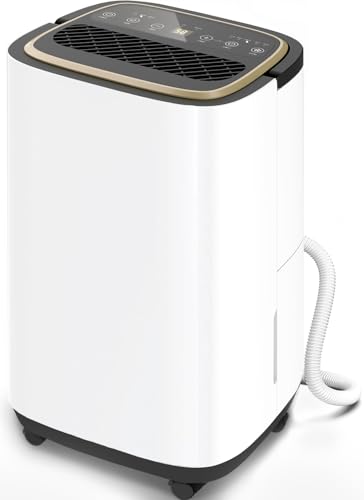
Pros
- Tank or continuous hose drainage
- Adjustable humidity control
- Laundry-drying mode
- Wheels and carrying handle
Cons
- Who should skip it: households without a drain option may need to empty the 1.6-gallon tank frequently
How to Choose Best Basement Dehumidifiers With Drain Hose
Match rated capacity to the space and moisture load
Coverage and pint-per-day figures are useful starting points, but they are not interchangeable. The listings use different test conditions, so compare the stated conditions as well as the headline number. KNKA specifies up to 80 pints per day in very humid conditions and 56 pints in typical basement conditions, while the AEOCKY listing specifies 105 pints per day in humid summer conditions and 83 pints in warm, damp basement conditions. GarveeHome lists 150 pints per day in its maximum claim and 65 pints in its basement condition.
For a large, persistently damp basement, a compressor model with a higher stated capacity may reduce how often the unit needs to run. For a smaller room, the compact Niuteri units are rated for up to 1,000 square feet and use semiconductor dehumidification, but their listing specifies up to 40 ounces of moisture removal, not the pint-scale output claimed by the larger compressor units.
Check whether gravity drainage works in your basement
A drain hose is only convenient when water can flow continuously to an appropriate drain. Check the hose length, connection style, route, and whether the drain point is lower than the appliance. KNKA includes a 6.56-foot hose, GarveeHome includes a 6.5-foot hose and a 3/4-inch male garden-hose adapter, and Tehanld lists a 60-inch hose. Yaufey includes a shorter 3.28-foot hose, while Spacekey and GoGuess list 3.5-foot and 3.28-foot hoses respectively.
Some models also allow tank operation. Tank sizes vary from the 0.66-gallon Spacekey tank to the 1.6-gallon Tehanld tank, and the listings describe automatic shutoff when full. If your basement drain is too high for gravity drainage, do not assume a hose alone solves the problem. Confirm the installation method in the manual or plan for a compatible pump setup only if the manufacturer supports it.
Consider noise, placement, and cool-room operation
Noise matters when the basement is used as an office, bedroom, or entertainment area. Listed sound figures range from 35 dBA for GarveeHome to 40 dB for Spacekey, GoGuess, and KNKA’s stated 40 to 45 dB range. These figures come from product listings, so treat them as specifications to compare rather than a guarantee of how the appliance will sound in your room.
Basements can also be cooler than living spaces. Spacekey lists auto-defrost operation in temperatures as low as 41°F, and Tehanld lists a frost sensor for operation in environments as low as 42°F. AEOCKY describes auto-defrost for cooler spaces and says its lowest fan setting is 44 dB. Verify the operating-temperature guidance before placing any model in an unheated basement.
Prioritize controls that match your routine
Adjustable humidity settings are more useful than a simple on-and-off switch when you want the unit to maintain a target level. Yaufey, Spacekey, GarveeHome, and Tehanld list adjustable ranges that reach from 30% to 80% RH. Modes can also change the workflow: KNKA lists Auto, Dry, and Setting modes, while Spacekey and GoGuess include dehumidifying, clothes-drying, and sleep-oriented modes.
A timer, auto restart, child lock, or humidity display can reduce daily adjustments, but choose only the controls you will use. Yaufey lists a 24-hour timer and auto restart, and several larger models list child locks. The Niuteri models add humidity displays, timers, three fan speeds, and a sleep mode, but their smaller moisture-removal claims make them a different category from the compressor units.
Plan for filter care and moving the appliance
All listed units should be placed where air can circulate and where the hose connection remains accessible. Washable filters can reduce the cost and inconvenience of replacement filters, but they still require regular removal and cleaning according to the manual. KNKA, Niuteri, Spacekey, and Tehanld specifically list washable or reusable filters.
Wheels and handles are practical if you move the appliance between a basement, laundry area, or garage. KNKA, GarveeHome, Spacekey, and Tehanld list casters or wheels and handles. Before buying, measure doorways and the intended parking spot, and leave enough access to remove the tank or filter.
How We Compared These Products
We compared the supplied product listings by stated moisture-removal capacity, coverage claims, drainage method, hose details, tank operation, controls, sound specifications, filter care, mobility, and cool-room features. The comparison is based on product research and published information, not on appliance use or independent measurements. Claims such as ENERGY STAR certification, ENERGY STAR Most Efficient status, and warranty coverage should be verified on the current listing and product documentation before purchase.
Which Option Fits Your Kitchen?
For a large basement where continuous drainage is the priority: Air-care appliances such as the AEOCKY 6000Sq.Ft Commercial Dehumidifier are worth considering because its listing specifies a 105-pint maximum claim, a drain hose, auto-defrost features, and a 44 dB lowest fan setting. Pros include high stated capacity and cool-space features. Cons include the commercial positioning and a larger 34 lb body. Who should skip it: buyers with a small room or limited need for high-capacity moisture removal.
For a broad mix of capacity and basement controls: KNKA Energy Star 5500 Sq.Ft Dehumidifier lists 80 pints per day maximum, a 56-pint typical-basement claim, a 6.56-foot hose, a washable filter, and adjustable humidity control. Pros include multiple modes, a larger tank than several alternatives, and listed 40 to 45 dB operation. Cons include the need to verify the optional external-tank arrangement and the 24-hour upright wait before first use. Who should skip it: shoppers who cannot provide the required upright setup or drainage path.
For a smaller room or compact moisture task: Niuteri Dehumidifier, 98OZ Dehumidifiers is listed for up to 1,000 square feet and uses a compact semiconductor design with a hose connection, humidity display, timer, washable filter, and sleep mode. Pros include low listed noise of 28 dB in sleep mode and simple maintenance features. Cons include the 40-ounce maximum moisture-removal claim, which is substantially different from the pint-scale compressor models. Who should skip it: anyone managing a large, persistently damp basement.
For a replacement hose rather than a dehumidifier: 12FT Dehumidifier Drain Hose with 3/4 Inch FHT lists a 12-foot length, a 3/4-inch fitting, brass hardware, and a rubber seal. Pros include extra reach and the ability to cut it to length. Cons include the need to confirm outlet compatibility, and it is an accessory rather than a moisture-removal appliance. Who should skip it: anyone who still needs a complete dehumidifier.
Other useful comparisons include 80 Pint Dehumidifier for Basement 5500 Sq. Ft., which lists four modes, a 1.06-gallon tank, and a 3.28-foot hose; 5500 Sq. Ft Dehumidifier,Max 150 Pint/Day Whole, which lists a 35 dBA claim and a 6.5-foot hose; 34 Pints Dehumidifier for Basement with Drain Hose, which lists auto-defrost and a 2,500-square-foot claim; 5000 Sq.Ft Dehumidifier for Basement with Drain, which lists a 50-pint claim and a 1.6-gallon tank; and GoGuess 2500 Ft² Max 34 Pints Large Room, which lists a 2.3-liter tank and sleep mode. The gray Niuteri Dehumidifier, 98OZ Dehumidifiers shares the listed core specifications of the white version, so color should not be treated as a performance difference. Each model’s main limitation is the same decision point: confirm that its stated capacity, hose length, and drainage method match your room.
Frequently Asked Questions
Can any included hose drain a basement dehumidifier continuously?
No. Continuous gravity drainage requires a compatible connection and a route that allows water to flow to the drain. Check the hose length, fitting, slope, and manual before relying on unattended operation.
Is a pint rating the same as the water-tank capacity?
No. Pint-per-day capacity describes the listed moisture-removal claim under specified conditions. The tank is a separate container, and a unit can remove more water per day than its tank holds when connected to continuous drainage.
Which type suits a very small basement room?
The Niuteri models are the smallest-capacity options in this group, with a listed 1,000-square-foot coverage claim and 40-ounce maximum removal claim. Compare the room’s actual moisture load before choosing them over a compressor model.
What maintenance do these dehumidifiers require?
Expect to clean the filter and keep the air intake and outlet clear. Models with washable filters still need routine care, and tank-based operation requires emptying the tank before the automatic shutoff interrupts operation.
Should I choose a model with auto-defrost for a cool basement?
Auto-defrost can be useful in cooler spaces, but the supported temperature range differs by model. Spacekey lists operation as low as 41°F, Tehanld lists 42°F, and AEOCKY describes cool-space auto-defrost. Verify the current manual for your room’s lowest temperature.
Does a drain hose eliminate the need for a water tank?
No. Most listed models provide both a hose option and a removable tank. The tank remains useful when a drain is unavailable, while the hose is more convenient when gravity drainage is correctly configured.
What should I verify before placing one in a basement?
Confirm the floor space, outlet location, hose route, drain height, operating-temperature guidance, and access for filter or tank removal. Keep the appliance upright as directed by its manufacturer, and follow the supplied electrical and placement instructions.






Write Your Review
No reviews yet. Be the first to share your experience!