

A small household may need a compact cooker for rice, beans, and one-pot meals, while a family cooking in batches may value an 8-quart vessel and a broad cooking menu. Choosing the wrong size can waste counter space or leave too little room for the portions you actually prepare.
This guide to the Best Electric Pressure Cookers compares capacity, cooking functions, controls, inner-pot materials, cleaning features, and pressure-release designs. Use it alongside our Pressure Cookers category to narrow the choice by routine rather than by feature count alone.

Pros
- Seven cooking functions in one appliance
- Six-quart capacity for family meals
- Dishwasher-safe lid, pot, and accessories
- Stainless-steel inner pot
- Recipe app included
Cons
- Large, heavy countertop footprint
- Power cord is permanently attached
- Who should skip it: Shoppers needing compact storage

Pros
- Large 8-quart cooking capacity
- Multiple cooking functions
- Customizable programs and delay start
- Dishwasher-safe lid and sealing ring
- Scratch-resistant ceramic inner pot
Cons
- Large footprint may challenge smaller kitchens
- Who should skip it: households needing a compact cooker
Pros
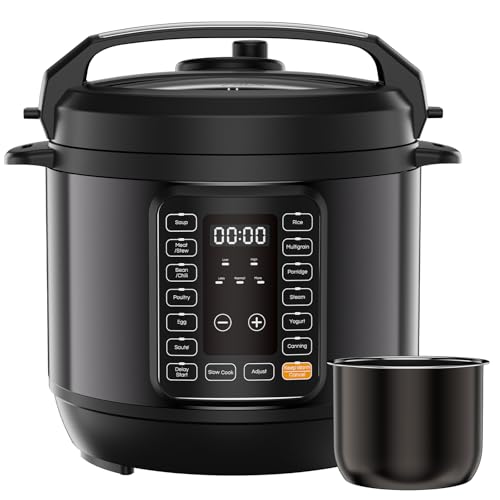
- 12 one-touch programs
- 24-hour delay start
- 6-quart capacity
- Dishwasher-safe removable lid and sealing ring
Cons
- May be more capacity than smaller households need
- Who should skip it: households seeking a simpler or smaller cooker

Pros
- 12 preset programs
- Manual cooking adjustments
- 24-hour delay start
- Dishwasher-safe lid and sealing ring
Cons
- Who should skip it: shoppers seeking a smaller-capacity cooker
Pros
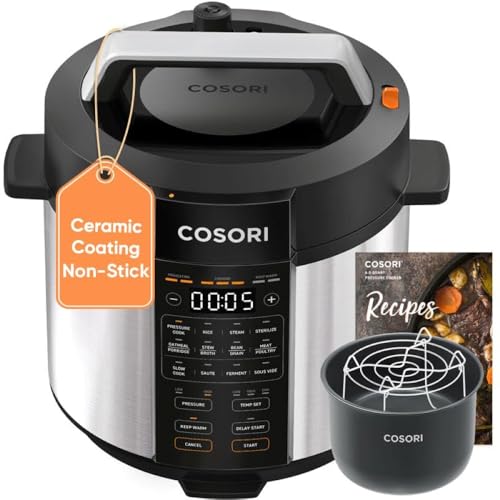
- Several cooking modes in one appliance
- Ceramic-coated inner pot
- Dishwasher-safe lid and accessories
- Fingerprint-resistant housing
Cons
- Many modes may be unnecessary for simpler cooking needs
- Who should skip it: cooks seeking a basic pressure cooker

Pros
- Ten preset cooking programs
- Delay start up to 24 hours
- Automatic keep-warm mode
- Ceramic-coated inner pot
Cons
- 3-quart capacity limits batch size
- Who should skip it: households needing larger cooking batches

Pros
- Nine cooking functions in one appliance
- Large 6.5-quart cooking capacity
- Wide searing and sautéing surface
- Removable serving pot
- PFAS-free ceramic nonstick coating
Cons
- Rice times exclude pressure building and release
- Who should skip it: Shoppers needing a smaller capacity cooker

Pros
- Ten cooking presets
- Compact 3-quart capacity
- Delay start up to 24 hours
- Ceramic-coated inner pot
Cons
- Small capacity may not suit larger households
- Who should skip it: cooks needing a larger-capacity cooker

Pros
- Family-sized six-quart cooking capacity
- Multiple cooking functions in one appliance
- Touchscreen controls with preset programs
- Quick and natural pressure release options
- Automatic keep warm function
Cons
- Six-quart size may be more appliance than smaller households need
- Who should skip it: Shoppers seeking a specialized single-function cooker

Pros
- Multiple cooking functions in one appliance
- Six-quart cooking capacity
- 24-hour delay start
- Dishwasher-safe lid and sealing ring
- Ceramic inner pot
Cons
- The 6-quart size may be more than smaller households need
- Dimensions and electrical requirements are not provided
- Who should skip it: Shoppers needing compact size or detailed electrical specifications
Capacity and the portions you actually make
Capacity affects both meal size and storage. The 3-quart OLIXIS models are aimed at smaller households, while the 6-quart options from Instant Pot, DUMOS, Cosori, and Chefman suit routine family meals or batch cooking. The 6.5-quart Ninja and 8-quart Sweetcrispy models provide more room for larger portions, but their larger vessels may be less convenient if your counter or cabinet space is limited.
Pros of the smaller OLIXIS cookers include a compact capacity, 10 preset programs, and a 24-hour delay start. Cons are the reduced volume and fewer listed functions than several larger models. Who should skip it: shoppers who regularly prepare large batches or family-size meals.
The 8-quart Sweetcrispy models offer family-oriented capacity, 16-in-1 functionality, and a ceramic inner pot. The trade-off is that the larger size can take more storage space, and the supplied information does not provide exterior dimensions. Who should skip them: anyone with a very tight counter or cabinet area who rarely cooks more than a few portions.
Cooking programs and control style
Preset menus can simplify familiar meals, but more programs do not automatically make an appliance easier to use. Sweetcrispy and DUMOS list 12 presets within 16-in-1 systems, while Instant Pot lists 13 customizable Smart Programs within a 7-in-1 appliance. Cosori lists functions including sous vide, ferment, sterilize, and keep warm, and Ninja lists pressure cooking, slow cooking, rice, sous vide, steaming, searing, sautéing, and yogurt.
Chefman uses a touchscreen with 13 one-touch functions, plus adjustable time and temperature settings according to the listing. Its advantage is an interface designed around touch controls, but buyers who prefer physical controls should compare the interface before ordering. Who should skip it: anyone who wants the simplest possible cooker and does not need its broader menu.
DUMOS and Sweetcrispy provide manual customization and a 24-hour delay start, which can help with planned meals. The trade-off is that programmable options still require you to understand which setting suits the recipe. Who should skip either model: shoppers seeking a specialized appliance rather than a multifunction cooker.
Inner-pot material and cleanup
Material changes how you approach cooking and maintenance. Instant Pot specifies a food-grade stainless-steel inner pot with a tri-ply bottom, while Sweetcrispy, DUMOS, Cosori, OLIXIS, and Ninja specify ceramic or ceramic nonstick cooking surfaces. Ceramic coatings may appeal to shoppers who prioritize food release and wipe-down cleanup, while stainless steel avoids relying on a nonstick cooking surface.
Instant Pot lists a dishwasher-safe lid, inner pot, and accessories. Sweetcrispy and DUMOS specify dishwasher-safe lids and sealing rings, Cosori lists a dishwasher-safe lid, ceramic inner pot, and accessories, and Ninja describes its removable PFAS-free ceramic nonstick pot as easy to wipe clean. These claims apply to the listed removable parts, not automatically to the entire appliance. Who should skip a coated-pot model: buyers who specifically prefer stainless steel and want to avoid a coated cooking surface.
The OLIXIS models list ceramic inner pots and stainless-steel outer shells, with the smaller size potentially easier to handle and store. Their drawback is that the supplied information does not identify dishwasher-safe parts. Who should skip them: shoppers who want clearly specified dishwasher care.
Steam release and safety-related design
Pressure cooking requires attention to the locking lid and steam-release controls. Instant Pot lists more than 10 safety features, overheat protection, and a safe-locking lid. Sweetcrispy and DUMOS list overheat and dry-boil protection plus a lid reminder, while OLIXIS lists pressure-release valves, heat sensors, and triple integrated safety protection.
Cosori specifically describes a seal/vent button positioned away from the steam-release valve and a backward-angled release design. Chefman describes quick and natural release choices, and Ninja lists a 1200-watt heating system, but the supplied Ninja information does not detail its release-control layout. These are listed design features, not a substitute for reading the manual and following the manufacturer’s instructions. Who should skip a model: anyone unwilling to learn the correct lid-locking and release procedure.
Delay start, keep warm, and meal planning
Delay start can help you organize ingredients ahead of time, while keep-warm mode can hold food after cooking. Sweetcrispy, DUMOS, OLIXIS, Chefman, and the listed Instant Pot features support some combination of these conveniences. Chefman also includes a removable condensation cup, which may help manage moisture during cooking.
These functions are useful for planned meals, but they do not remove the need to choose suitable ingredients, timing, and release settings. Who should skip a model with these features: shoppers who do not use scheduling or warming and would rather prioritize a smaller control panel or simpler appliance.
How We Compared These Products
We compared the supplied product specifications, listed functions, control designs, inner-pot materials, cleaning information, capacity claims, and safety-related features. The product data also includes customer rating information, but it does not document a recurring review pattern or independent performance measurements. This is product research based on the supplied listings, not a report of physical evaluation.
Which Option Fits Your Kitchen?
For smaller portions and limited storage: The Cooking category includes many space-conscious appliances, but within this selection the OLIXIS 10-In-1 Electric Pressure Cooker is the clearest fit because its listed 3-quart capacity is intended for small households. It also includes rice, stew, steam, yogurt, and delay-start functions. Its smaller capacity is a reason to choose a larger model if you batch cook.
For larger meals: The Sweetcrispy 16-in-1 Electric Pressure Cooker 8QT offers the largest listed capacity in this group, along with 12 presets, manual customization, and a ceramic inner pot. The Ninja® HyperHeat™ 9-in-1 Pressure Cooker, 6.5-qt is another option for larger households, with a removable serving pot and listed capacity for meals serving 8 to 10 people. Verify available clearance before choosing either larger design.
For stainless-steel inner-pot preference: The Instant Pot Duo 6 Qt 7-in-1 Electric Pressure specifies a food-grade stainless-steel inner pot with a tri-ply bottom and lists dishwasher-safe removable parts. It has fewer listed appliance categories than some 16-in-1 models, so choose it when the pot material and established seven-function layout matter more than maximum menu breadth.
Frequently Asked Questions
What size electric pressure cooker should I choose?
Choose based on your normal batch size and storage area. The listed choices range from 3 quarts for smaller households to 8 quarts for larger portions, with 6 to 6.5 quarts occupying the middle of the selection.
Is a ceramic inner pot better than stainless steel?
Neither is universally better. Ceramic and ceramic nonstick surfaces may suit shoppers who prioritize food release and easy wipe-down, while the Instant Pot’s listed stainless-steel pot may suit buyers who prefer that material and a tri-ply bottom.
Are these entire pressure cookers dishwasher-safe?
No listing supports that broad conclusion. Specific removable parts are described as dishwasher-safe on some models, so check the manual for the lid, sealing ring, inner pot, and accessories before placing any part in a dishwasher.
Can these appliances replace a rice cooker or slow cooker?
The listed models include rice-cooking and slow-cooking functions, so they are designed to combine those tasks with pressure cooking. Confirm the exact programs you need because function counts and menus vary by model.
What should I check before storing one on a counter?
Check the appliance’s exterior dimensions, lid clearance, access to the controls, and room for steam release. Dimensions are not supplied for these products, so verify them on the current listing or manual before buying.
Which pressure-release features matter?
Look for a clear lid-locking system and a release design you can operate while keeping your hands away from escaping steam. Cosori lists a seal/vent button positioned away from the release valve, while Chefman lists quick and natural release choices. Follow the manufacturer’s instructions for every model.






Write Your Review
No reviews yet. Be the first to share your experience!